

Tuesday, October 7, 2008

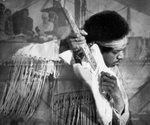
THE JIMI HENDRIX EXPERIENCE - BOX SET (4 CD) @flac

Engineer Eddie Kramer was in charge of the project. He is a familiarfigure as his posthumous Hendrix production credits go back to The Cry Of Love in 1971. The tracks sound terrific as he re-mastered the sound with modern equipment which gives the music a polished feel. He also presents the tracks in chronological order which is always welcome with
projects this extensive.

Disc one finds three unreleased tracks. “Title #3,”
“Taking Care Of Business,” and “Here He Comes” may not be of the
quality of Hendrix’ first album but they certainly present his musical
vision circa 1967. The gems of this first disc are alternate versions of
such classics as “Purple Haze,” “Foxey Lady,” and “Third Stone From
The Sun” which give a glimpse into the creative mind of Jimi Hendrix.

Disc two presents some excellent live tracks. “Fire” is taken from a 1968
concert at Clark University in Massachusetts. It is a frenetic version that
shows just how technically sound Hendrix was as a guitarist. “The Wind
Cries Mary,” from a 1967 Paris concert, shows Hendrix’s softer side as
he provides subtle and melodic improvisations. “Burning The Midnight
Lamp” from September 5, 1967, is just Hendrix squeezing every possible
sound from his guitar.

Disc three is dominated by alternate versions. It is nice to hear “Hear My
Train A Comin’” as a formative track as it was a concert staple. “Spanish
Castle” and “Room Full Of Mirrors” show subtle differences from the
recognized versions. Live versions of “Little Wing” and “Voodoo Child”
come complete with feedback and all sorts of distortion that only Hendrix
could produce on stage.

Disc four is a feast of unreleased material. “Country Blues,” at over eight
minutes, “Lover Man,” “Cherokee,” and “Slow Blues” all make their
debuts. Hendrix’ early producer, Chas Chandler, did not approve of Alan
Douglas’ changing Hendrix’s material and even taking writing credits
during the twenty years that he controlled Hendrix’s catalogue of music.
When Jimi’s family won back control in a court battle, Chandler turned
over a treasure trove of unreleased material to them. “In From The
Storm” and “Slow Blues” close out the set as they were recorded at the
Isle Of Wight Music Festival, August 30, 1970, just prior to Hendrix’s
death.

The Jimi Hendrix Experience Box Set is a valuable addition to the
Hendrix legacy. Not only does it expand the music that Hendrix left
behind but it also solidifies him as a genius of the guitar who forever
changed the use of that instrument and rock music. (D.B.)


Disc 1: h!!p://www.megaupload.com/?d=YNWJ4GG1
536MB

Disc 2: h!!p://www.megaupload.com/?d=LDXNXPWL
424MB

Disc 3: h!!p://www.megaupload.com/?d=64EZLKAX
412MB

Disc 4: h!!p://www.megaupload.com/?d=UYLNBV56
483MB

Sunday, October 5, 2008

GREENSLADE - same (@flac)

One of the most underrated prog-rock bands of the 1970s, Greenslade included former members of Colosseum and King Crimson, and they lived up to that impressive pedigree. On their debut album, they unveiled a dual-keyboard-charged sound powered ... Full Descriptionby ivory ticklers Dave Greenslade and Tony Lawson. While the band displayed an instrumental facility right in line with the emerging symphonic wing of prog, they were distinguished by two rarities in the genre: trace elements of R&B (perhaps the Colosseum connection) and lyrics that display an actual sense of humor. Great stuff!!!

Greenslade - Chalkhill


Link: h!!p://www.megaupload.com/?d=KJ7PQRTH

Friday, October 3, 2008

INTERMEZZO No 1

FUNNY SIDE OF MUSIC

Hurra Torpedo - Total Eclipse of the Heart

Thursday, October 2, 2008

NICK DRAKE - Pink Moon (1972) @flac

Pink Moon is the sound of Nick Drake cracking up. That's not exactly true--some have long thought that his death by an overdose of an anti-depressant was an accident, and not suicide--but this album, recorded over two late nights, certainly sounds like a fever dream. Peter Buck of R.E.M. has called the album "Like an English version of (Robert Johnson's great blues) `Hellhound on My Trail.'" The lyrics to the title song read in their entirety: "Saw it written and I saw it say, pink moon is on its way. None of you will stand so tall, pink moon is gonna get ye all. And it's a pink moon." Aside from a splash of piano, the only instrumentation on this stark and spooky collection is Drake's eloquent acoustic guitar. J.M.

Link: h!!p://www.megaupload.com/?d=XE9WG3XZ

NICK DRAKE - Bryter Layter (1970) @flac

The second album from Nick Drake came in 1970, and while not quite as melancholy as his debut, Five Leaves Left, there are certain brooding qualities that continued to propagate the Nick Drake mystique. Horns, flute, and strings arrangements lift such songs as "At the Chime of a City Clock" and "Hazy Jane I" and "II" out of the realm of sad, folk-guitar music into something jazzier and lighter, while the beautiful piano and simple guitar of "One of These Things First" laments what could have been without sounding like a song of despair. But two tracks featuring John Cale on various instruments (such as viola and harpsichord) have the dark fragility of "Pink Moon": the lovely "Fly" is a fragile apparition, and "Northern Sky" is a dreamy, brooding plea for long-lasting love. L.F.

Link: h!!p://www.megaupload.com/?d=U432TQVM

NICK DRAKE - Five Leaves left (1969) @flac

There's not a single dud in the trilogy of albums that singer/songwriter Nick Drake released during his all-too-short career. And 1969's Five Leaves Left--his first album--is certainly no exception. Drake's sensitive guitar work and sensitive vocals are backed by the baroque sounds of a chamber string group, and the platter's lyrics show maturity well beyond the age of their 20-year-old creator. Sparser than its follow-up, the jazzy Bryter Layter, but less tortured than Drake's dark final chapter, Pink Moon, Five Leaves Left is a classic British folk disc. Songs like "River Man," "The Thoughts of Mary Jane," and "Day Is Done" are among Drake's finest moments. J.V.

Nick Drake - River Man


Link: h!!p://www.megaupload.com/?d=JRSQJPEE

Wednesday, October 1, 2008

BLOODROCK - same (1970) @flac

First off....let me set the record straight about Fantastic piece of architecture"......It is about a superb architect who builds a structure that recieves phenomenol acclaim.....he does NOT walk into the parlor and fall dead immediately afterwards....it actually talks about how the structure....in comparison to the architects own life...suffers the ravages of life...and existence....as the architect ages and becomes frail.....eventually lying down and dying in the parlor of his masterpiece.....so does the masterpiece die.....the love that the architect had for his creation...died with him....or something along that line.....and NO..it isnt party music.....it's think music.

There are some excellent rockers on this album..and some nice ballads as well.

Bloodrock - Fatback


Link: h!!p://www.megaupload.com/?d=1D5R2CWP

IGRA STAKLENIH PERLI - same (1979) @flac

IGRA STAKLENIH PERLI, the ultimate ex-Yugoslavian space/psychedelic rock band, was formed in 1976 in Belgrade, Serbia, having been named after the famous novel by Hermann Hesse - "Das Glasperlenspiel" (The Glass Beads Game). The original line-up consisted of: Zoran Lakic (keyboards), Vojkan Rakic (guitar), Predrag Vukovic (percussions) and Drasko Nikodijevic (bass & vocals). In late 1977 Dragan Soc joined the band as drummer while they played live concerts at Belgrade clubs, preparing to start recording their first album, which they did in mid 1978. Upon its release the next year, the band gained reputation for elaborated visual stage effects and light show directed by their friend Goran Cvetic. Nikodijevic was replaced by rock journalist Slobodan Trbojevic on bass prior to recording the second album in late 1979. After its release in 1980 the guitarist Ivan Pajevic replaced Rakic and Nikodijevic was back on bass, but shortly the band ceased to exist. Nikodijevic and Rakic later formed post-punk/neo-psych White Rabbit Band but in late 1980s moved to USA where they continued under the name White Rabbit Cult. The remaining members together with German publisher Thomas Werner released at the beginning of 1990s three albums of ISP old live material and album outtakes for the German-based label Kalemegdan Disk.

IGRA STAKLENIH PERLI labelled their music style as "stream of consciousness music". Their both studio albums, the first eponymous "Igra Staklenih Perli" from 1979 and the second "Vrt Svetlosti" from 1980, are pretty similar in sound and resemble the style from early PINK FLOYD and HAWKWIND psychedelia, to German kraut-rock (notably CAN and TANGERINE DREAM), to HILLAGE-era GONG among many. Interesting music effort especially considering the fact it was the new wave boom period when they tried to pursue a quite different music philosophy.(PA)

IGRA STAKLENIH PERLI - Voyage Into The Blue


Link: h!!p://www.megaupload.com/?d=POOS4OHX

Tuesday, September 30, 2008

ROBIN TROWER - Long Misty Days & In City Dreams (@flac)

I've been a Robin Trower fan since hearing the first note he recorded with Procol Harum. I kind of lost track of him after his outing with Jack Bruce but have recently begun to acquire on CD what I have on album.
BGO is pairing up some of the old Trower albums in order of issue. Unlike the last set (For Earth Below and Robin Trower Live), the two albums here complement one another in such a way that it seems they should have been issued together.
I like Trower's hard-rocking songs, there are plenty on offer here: Same Rain Falls, Hold Me, Pride, Further On Up The Road, and Caledonia. But I also like his more experimental and innovative side: Somebody Calling, Smile, Love's Gonna Bring You Round, and In City Dreams. Guitar lovers will thrill to Trower's heroics and James Dewar's matchless voice gives depth and soul to his music in much the same way that Jack Bruce's vocals expressed the soul of Cream.
There is also a softer angle to some of Trower's songs which sometimes works very well, as on Sweet Wine of Love and Little Girl, though Dewar's voice is usually at it's best on the grittier songs.
Long Misty Days and In City Dreams feature some of the best of Robin Trower's early solo work. If you have been with Trower all along, you already know that. But if you are a recent convert. this is one of the key recordings you should add to your collection. BGO has put together a pairing that really works and is worth every penny of the price. (K.H.)

Link: h!!p://www.megaupload.com/?d=7H66DS5M

ROBIN TROWER - For Earth Below & Live (@flac)

The critical album on this release is "Live." Anyone curious to hear how good an electric guitar can possibly sound should purchase this CD. Trower deals in both overdriven and clean sounds with his Fender Strat, and his use of effects like the wah-wah pedal and the Uni-Vibe, while sometimes drawing unfair and shallow comparisons to Hendrix, is unparallelled in grace and style.
When Trower unleashes a sustained feedback note (i.e. near the end of "Daydream"), I want it to last thirty minutes. But he's also capable of dramatic bursts and flurries of notes, punctuated by bends and whammy bar workouts ... as Robert Fripp himself noted, Robin Trower has mastered the "bends and wobbles."
During the last solo of "Lady Love," Trower plays a pinch harmonic that is THE sweetest single note I ever heard, anywhere.
Jimmy Dewar lays down a great bass groove throughout - and his voice is quite powerful. He has a rich, soulful vibrato that compliments the music nicely.
Bill Lordan is a good, jazzy drummer, although occasionally his cymbals do clutter the sound, especially on the live album. But let's face it, the reason we are all listening to this is to hear what Robin is gonna play next :)

Link: h!!p://www.megaupload.com/?d=43WF8R57

ROBIN TROWER - Twice Removed From Yesterday & Bridge Of Sighs (@flac)


Robin Trower's debut & second solo album after departing the confines of Procol Harem (best known for the song "A Whiter Shade of Pale") is a celebration of his freedom from the group and explorations into the distorted blues stylings of the late Jimi Hendrix. Accused by many of ripping off Jimi's sound, Robin would say that in order to make any progress as a modern guitarist, one would have to go through Jimi. The palate of songs is a wide one, varying from the slow tempo and ethereal feel of "Daydream", "Hannah", and "Ballerina", to more upbeat electric R&B stylings of "Man of the World", and "I Can't Stand It". There are some attempts at progress in the title track, but listening to them 35 years later, you can definitely date the sound to its time period, similar to some of Steve Miller's work of this time. If you are a Hendrix fan, and are new to Robin's music, I would recommend to listen the "Bridge of Sighs" album first.

Robin Trower - Bridge of Sighs


Link: h!!p://www.megaupload.com/?d=HNOG8BO9

Sunday, September 28, 2008

RUSH - Hemispheres (1978) @flac


Rush were just on the brink of being embraced by the album rock mainstream when they recorded Hemispheres. Already wildly popular with a certain corner of the intellectual crowd, thanks in part to drummer Neil Peart's Ayn Rand obsession, this CD marked a turning point for the Canadian trio. Hemispheres explores the political, social economic, and sci-fi themes prevalent on their early work, continuing the saga of "Cygnus" from A Farewell To Kings. Rush was fond of writing in movements, almost orchestrally, rather than the typical verse/chorus/verse/chorus structure, and Hemispheres has the usual opus-like compositions that perfectly displayed their chops. The CD features time changes that you'd need a calculator to crack, impossible guitar arpeggios from Alex Lifeson, and Geddy Lee's low end bass rumblings and high end vocal shriekings. Rush's lofty lyrics sometimes bordered on the ridiculous and, if for no other reason, Hemispheres deserves props for Lee's ability to sing the line, "There is unrest in the forest..." (from "Trees") while keeping a straight face. (S.G.)

Link: h!!p://www.megaupload.com/?d=7MVS95P3

RUSH - A Farewell To The Kings (1977) @flac


It's interesting to listen to Rush's albums in chronological order, and to hear how things had progressed from album to album. After hearing what had been created on Rush's 1976 breakthrough, _2112_, we could see the band perfecting what had been hinted at on earlier albums. And, here, on the effort that followed _2112_, we witness, yet another evolution.

On 1977's _A Farewell To Kings_, we see Rush entering a more evolutionary period in their writing. To me, this album, in many ways, is a bit more pivotal than their previous album, in foreshadowing what the band would be famed for in albums like 1981's _Moving Pictures_. For instance, in *sound* value alone, the sounds that are found here are much more akin to what you would hear on the later-era, more accessible, streamlined prog-rock in their early-80s period. Also, the instrumentation, and how it is treated is important: it was on *this* album where Rush started to employ more exotic instruments into their repetoire, and in drove-like fashion: tubular bells, wind chimes, bass pedal synthesizers, orchestra bells; these types of airy instruments and sounds were fairly prominent in the _Permanent Waves_-era Rush. And, also as important, it was on *this* album, where Rush started to delve heavily into the use of odd time signatures, and the multiple use of them.

Rush - A Farewell to Kings


Link: h!!p://www.megaupload.com/?d=UUN61DCS

RUSH - 2112 (1976) @flac


Only Rush could have pulled this off, and only in the '70s. 2112--the title suite of the band's 1976 breakthrough album--is a comically pretentious, futuristic rock opera written by a nerdy drummer and sung by a whiny-voiced geek. It also happens to be a great piece of rock & roll that lifts the listener through a variety of moods and textures from genteel acoustic ("Oracle") to thrilling metal ("The Temples of Syrinx"). Perhaps realizing that they had taken conceptualism about as far as it could go, even these guys backed off on the epic hero stuff for later releases. 2112 still stands as one of the great signposts of the prog-rock era.(M.R.)

Link: h!!p://www.megaupload.com/?d=V0ZP84SY

Saturday, September 27, 2008

CAMEL - Mirage (1974) @flac


UK reissue of 1974 album, remastered from the original tapes & includes 4 bonus tracks 'Supertwister' (recorded live at The Marquee Club), 'Mystic Queen' (recorded live at the Marquee Club), 'Arubaluba' (recorded live at The Marquee Club) & 'Lady Fantasy-Encounter/Smiles For You/Lady Fantasy' (previously unreleased version). 2002.

2nd release from CAMEL which I would rank as one of my favorites from their discography. Heavily rooted in their classic sound, "Mirage" is a great exploration into CAMEL's soft instrumental passages and sonic harmonies. There are not any thunderous crashes or loud bangs on "Mirage" which instead work on warm and soothing space textures. The classic CAMEL line up is present (Bardens, Ward, Latimer and Ferguson) who perform to their best standard! "Mirage" contains 2 epic tracks ("Nimrodel The Procession The White Rider" and "Lady Fantasy") which are given lots of space to explore a fine range of dimly lit moods and melodies. Song are superbly crafted and contain some of CAMEL's most treasured musical moments. (J.U.)

Camel - Lady Fantasy Excerpt [Guitar Solo] - Live 1976


Link: h!!p://www.megaupload.com/?d=E73YA5U8

BOWIE - Hunky Dory (1971) @flac

Hunky Dory was Bowie's last album as a wannabe, just before he found fame with Ziggy Stardust. It's a fascinating work on many levels, displaying lyrical depth, wit and great musical variety, from the music hall pop of Changes, through the sixties pop of Oh You Pretty Things to the cinematic lyricism of Life On Mars, a soaring masterpiece. Another of my favorites is Fill Your Heart, a quirky number with his somersaulting voice over lively piano and cheeky sax. Elements of the folk singer/songwriter are evident on numbers like Song For Bob Dylan while The Supermen reminds me of his later science fiction work. Bowie also salutes Lou Reed and Andy Warhol here, in fact the whole album makes references to his musical influences. It is a bridge between his earlier music hall style and the glamrock that was to follow, and this was just the right mixture to ensure a timeless classic. (P.T.)

Link: h!!p://www.megaupload.com/?d=SCU22PYR

BOWIE - The Man Who Sold The World (1970) @flac


In November 1970, David Bowie released his 3rd studio album and the promise that showed on the previous year's release was brought to fullfillment on 'The Man Who Sold the World'. Tales of madness, the occult, science fiction, maniac Vietnam vets and a race of superhumans fill this bizarre masterpiece of sonic indulgence. Some have commented on this record being David's heavy metal piece and in some parts the guitars are very heavy for 1970 (excepting of course Zep, Purple and the Sabs), but in many ways it is typical early Bowie record, especially lyrically. The Spiders from Mars make their debut here (with producer Tony Visconti handling the bass chores). Mick Ronson was the actual session leader on these recordings as newlywed Bowie was "preoccupied". Maybe that was the reason for the overabundance of heavy rock but much of Bowie's later work would be heavy as well. Favorites include the epic "Width of a Circle", an alltime favorite of mine which incorporates many of Bowie's early influences including legendary occultist Aleister Crowley. "All the Madmen" which explores the nature of insanity and touches on David's own troubled psyche while sympathizing with the plight of his half brother Terry. "Savoir Machine" and "Circle" explore the nature of false leadership and gods ("You can't stake your lives..."). "Running Gun Blues" explores the psychosis of war and its impact on soldiers who can't shut it down while back home. Both "After All" and "The Supermen" explore the ideas of Nietzsche and possibly Lovecraft describing a race aliens who resemble humans but are superior. Many of these will continue in future albums, especially 'Ziggy'. The most famous song on an album of non-hits is undoubtably the title track and it is a brilliant piece of work which stands up to the best of Bowie. A young man in a fragile state of mind? A blissfully ignorant hippie youth? A genius flaunting what was exceptable in rock music? Probably a little of all three which would show its first full bloom on this strange, troubling but brilliant record. (M.H.)

Link: h!!p://www.megaupload.com/?d=8VNZEXID

BOWIE - Space Oddity (1969) @flac


Somewhere between the Summer of Love and the reign of Ziggy Stardust, a lad named David Jones was breaking away from stage-driven theatrical music and trying to define a new image for himself. In 1969, he finally hit, with a strangely naïve but engrossing song entitle "Space Oddity". The lyrics showed very little in the knowledge of space travel, but spoke volumes about the inherent loneliness of an age when such a thing was accomplished and blithely accepted by the public at large. David Bowie (as he has dubbed himself) was `on the map', so to speak. America would need to wait a few more years before Bowie would conquer our shores in the guise of Lady Stardust, but his imprint was profound enough for this late 60's timepiece to see the light of day some time in 1972.
At the time, Space Oddity (the album, not the song) seemed to suffer a bit from its lack of timeliness. The album betrayed Bowie's affinity toward Dylan, if not openly, than certainly in subtler ways. The wordplay of "Unwashed and Somewhat Slightly Dazed" and "Cygnet Committee" simply could not have existed without Dylan's influence. For fans of Ziggy Stardust and the Spiders From Mars, this was an anachronism of the worst kind, a songwriting foible that Bowie had yet to overcome. Seen from today's perspective, however, this album has managed to survive quite nicely. Besides the title track, songs like "Janine" and "God Knows I'm Good" hold up as pleasant, if not particularly significant pop music. Believe it or not, the album even contains a blues-based jam (the afore-mentioned "Unwashed and Somewhat Slightly Dazed") that sounds more contemporary now than it did then!
Throughout his career, Bowie has toyed with his image, thus forcing his audience to think, or at least react, to his changes. "Space Oddity" presents an opportunity for fans to hear Bowie as an `unwashed' young man, searching for his first truly successful identity. It might not appeal to everyone, but anybody who has an appreciation for Bowie's ability to morph himself into various shapes will certainly find themselves fascinated by his first attempts at becoming a rock star. (T.R.)

David Bowie - Space Oddity


Link: h!!p://www.megaupload.com/?d=CB5GKCO3

Friday, September 26, 2008

Hi there!!! I`m back!!!


Hi rock friends! Yust to inform you that I am back again and albums will follow soon. All of them will be uploaded in flac, or ape format. Please no reupload requests. C U SOON...

Thursday, July 10, 2008